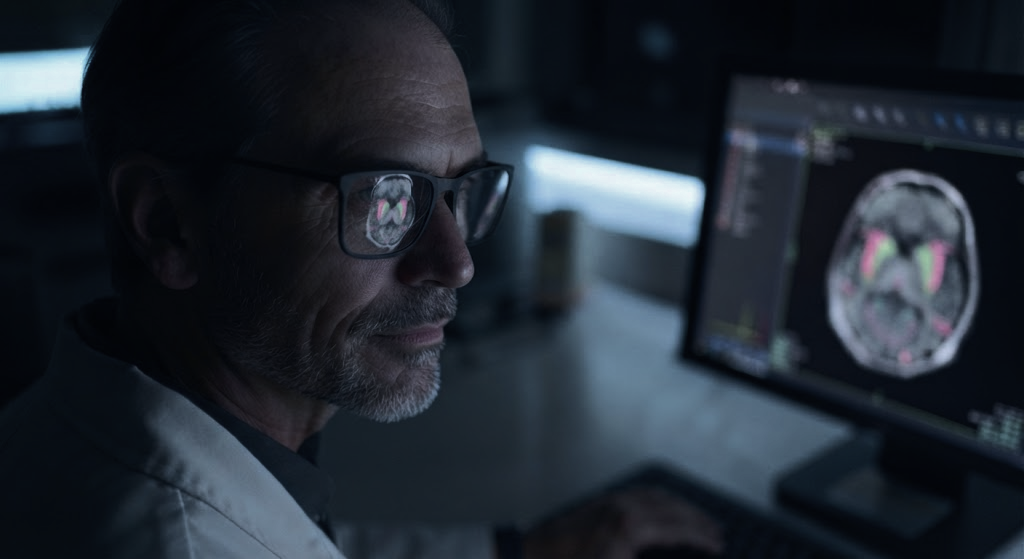
Every day in a hospital involves processing a high volume of imaging studies under considerable pressure. Against this backdrop, organisations and hospitals are already exploring how artificial intelligence algorithms can optimise their workflow and speed up the analysis of patient data. The main aim is not to replace expert judgement, but to provide tools and support that reduce the workload and time spent on tasks by assisting medical staff in their day-to-day work.
The current situation in medical imaging diagnostics
Various sources and specialist publications examine the impact of these technologies on day-to-day hospital operations. Recent analyses of artificial intelligence in radiology show that these systems excel at repetitive volumetric measurements, the automatic segmentation of structures and the detection of patterns in various types of scans, such as CT scans and MRI scans.
Other sources highlight that the value of these tools lies in their ability to carry out automated triage and prioritise cases on worklists within hospital systems. Furthermore, several specialist healthcare centres agree that the support provided by artificial intelligence streamlines decision-making, allowing the medical team to devote more time to a comprehensive assessment of each patient.
Visual results and improved quality in radiological imaging
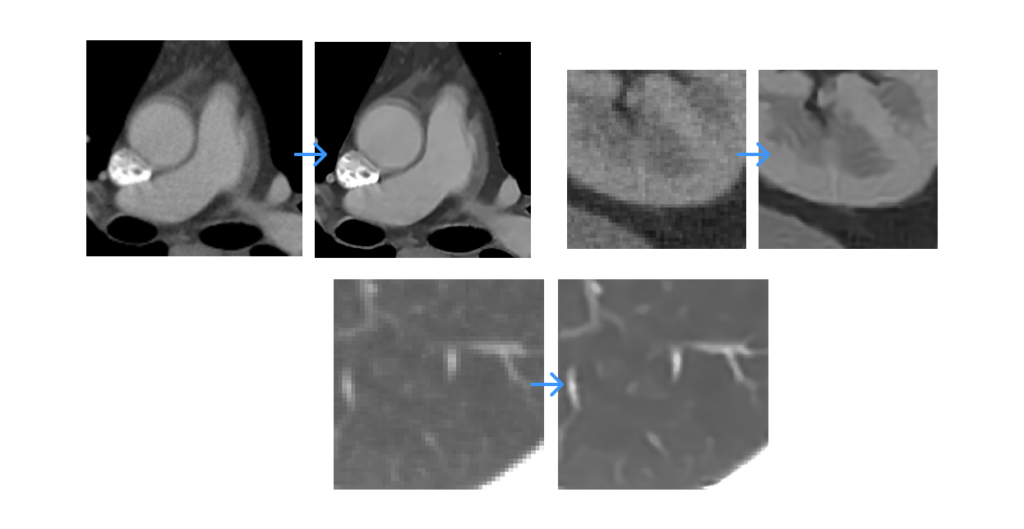
The visual results demonstrate the direct impact of super-resolution algorithms on medical imaging and image quality enhancement:
- Noise and pixel correction: Initial images with sampling limitations, noise or artefacts are processed using deep learning algorithms that remove blurring without inventing information.
- Information recovery: The system reconstructs spatial frequencies, enabling clearer visualisation of vascular contours, nodules or tissue transitions that went unnoticed in the original X-ray.
- Probability maps: Visual guides are generated on the scan, highlighting the areas of interest that have been analysed, facilitating rapid localisation for review by the specialist.
The algorithms process large volumes of data to highlight areas of interest, calculate volumes and generate reconstructions that make it easier to understand the anatomy and the affected areas.
Data on efficiency and optimisation of working time in radiology
Recent hospital experiences in radiodiagnostics show concrete operational improvements: the automation of screening reduces the average time taken to read and interpret complex studies by between 30% and 50%, helping to reduce the daily backlog of pending tests. Furthermore, the use of image enhancement modules in CT scans reduces the required radiation dose by up to 40%, whilst maintaining diagnostic clarity without increasing patient scan times.
Core AI: artificial intelligence applied to radiological analysis
Against this backdrop of technological change and the current boom in AI, Core AI represents an approach focused on providing processing capabilities to visualisation and analysis platforms.
Integrating artificial intelligence into hospital workflows, and specifically into radiology, enables complex datasets to be processed more efficiently, whilst keeping the specialist at the heart of all decision-making. The technology works in the background, helping to transform patient information into greater safety and more accurate diagnoses.